
Mu’s Mansion (木府, Mùfǔ), also known as the Mu Family Mansion or Mu Residence, is the historic palace-style complex of the Mu clan, the hereditary Naxi tusi (native chieftains) who ruled the Lijiang region for centuries. It sits in the southwestern part of Lijiang Old Town (UNESCO World Heritage Site), at the foot of Lion Mountain (Shizi Mountain).
History
The Mu family rose to power under the Mongol Yuan dynasty and was formally granted the Chinese surname “Mu” by the Ming founder Zhu Yuanzhang in 1382 after the Naxi leader Ajia Ade submitted to the Ming. They governed as hereditary tusi through the Ming and into the early Qing (roughly 22 generations, spanning about 470 years until the gaitu guiliu reforms of 1723 replaced native rule with direct imperial administration).
The mansion served as both private residence and administrative yamen (government office). Contemporary accounts, including the famous traveler Xu Xiake (who visited in 1639), praised its grandeur, comparing it to a royal palace (“宫室之丽,拟于王者”). Much of the original complex was destroyed in late Qing warfare and further damaged in the 20th century and the 1996 Lijiang earthquake. The present buildings were carefully reconstructed between 1996 and 1999 (with significant World Bank support) on the original site in Ming-dynasty style and opened as a museum (Lijiang Ancient Town Museum).
Architecture and Layout
The complex covers roughly 46 mu (about 3 hectares / 8 acres) with a 369-meter central axis oriented eastward (toward the rising sun). It blends Han Chinese imperial symmetry and formality with Naxi, Bai, and other local crafts and aesthetics. Key structures along or near the main axis include:
Stone Arch of Loyalty and Righteousness (忠义坊) — bearing imperial inscriptions
Ceremonial gates and Assembly / Council Hall (议事厅)
Wanjuan Tower (万卷楼, “Ten Thousand Scrolls Pavilion”) — historically a major library holding Dongba manuscripts, Buddhist texts, Chinese classics, and family collections
Dharma / Guardian Hall, Guangbi Tower, Yuyin Tower (Jade Sound / Imperial Edict Tower)
Sanqing Hall (Three Purities Hall, reflecting Daoist influence)
Side halls, courtyards, corridors, stage, and residential areas (over 160 rooms in total)
The overall effect is often nicknamed a “miniature Forbidden City of the South.”
Visiting Information
Location**: No. 49 Guangyuan Alley (官院巷), Guangyi Street, inside Lijiang Old Town. Easy walk from Sifang Square (about 10 minutes westward along the canals).
Opening hours**: Typically around 08:00/08:30–17:30/18:00 (confirm locally as times can vary by season).
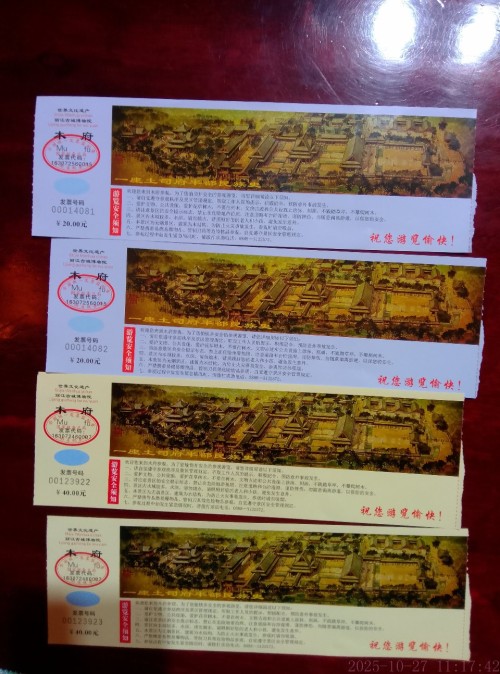
Tickets**: Approximately 40–80 CNY for adults (prices have varied in reports; check current rates). Discounts often available for students, children, and seniors. Audio guides or live guides are commonly available.
Time needed**: 1.5–3 hours.
Highlights**: Architecture, historical exhibits on the Mu tusi system and Naxi culture, views toward the Old Town and (on clear days) Jade Dragon Snow Mountain, occasional cultural performances or demonstrations.
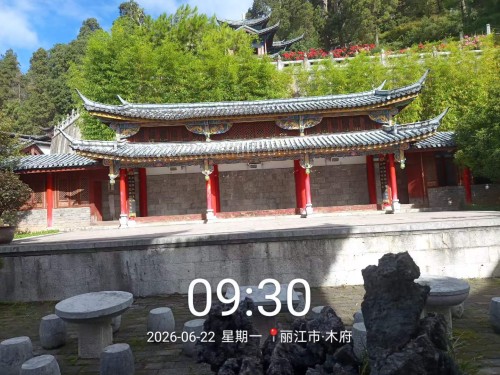
Mu’s Mansion is one of the best places in Lijiang to understand the political power, cultural sophistication, and multi-ethnic interactions of the Naxi elite under the Chinese imperial tusi system. It complements visits to the Old Town streets, Black Dragon Pool, and Dongba cultural sites.