
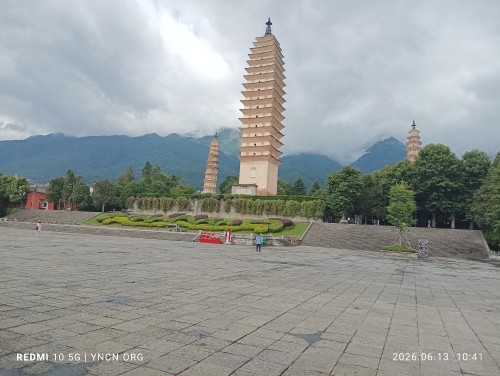
The Three Pagodas are Dali’s most iconic landmark — a trio of ancient Buddhist towers that have stood for over 1,200 years between Cangshan Mountain and Erhai Lake.
Architecture & Layout
The three pagodas are arranged in an isosceles triangle formation, with the main pagoda in the center and two smaller ones flanking it to the north and south.
| Pagoda | Name | Height | Stories | Shape | Dynasty Built |
|---|---|---|---|---|---|
| Main | Qianxun Pagoda (千寻塔) | 69.13 m | 16 | Square | Tang Dynasty (Nanzhao Kingdom, ~823–859 AD) |
| North | North Small Pagoda | 42.19 m | 10 | Octagonal | Song Dynasty (Dali Kingdom, ~1108–1172 AD) |
| South | South Small Pagoda | 42.19 m | 10 | Octagonal | Song Dynasty (Dali Kingdom, ~1108–1172 AD) |
The main Qianxun Pagoda is a square, multi-eaved hollow brick pagoda in classic Tang Dynasty style — similar to Xi’an’s Small Wild Goose Pagoda. The two smaller pagodas reflect Song Dynasty elegance with their octagonal design.
History
Origins (9th Century)
Built during the reign of Nanzhao King Quan Fengyou (劝丰祐, 824–859 AD), the pagodas were originally part of the grand Chongsheng Temple — the royal monastery of the Nanzhao and later Dali Kingdoms.
The “Buddhist Capital”
-
890 rooms
-
11,400 Buddha statues
-
Used 40,590 jin of copper
-
9 of the 22 kings of the Dali Kingdom became monks here
This is why Dali was known as the “Land of Fragrant Buddhas” (妙香佛国). The temple also inspired the Tianlong Temple in Jin Yong’s famous wuxia novel Demi-Gods and Semi-Devils.
Destruction & Survival
The original Chongsheng Temple was destroyed by war during the Qing Dynasty — only the Three Pagodas survived. The current temple complex was rebuilt in 2005 near the original site.
The Earthquake Miracle
-
1514 (Ming Dynasty): A massive earthquake caused the Qianxun Pagoda to crack “like a split bamboo” — yet it healed itself within 10 days.
-
1925: Another devastating earthquake destroyed 99% of Dali’s houses. The pagodas only lost their top ornaments.
The pagodas have actually been leaning for over 400 years but remain structurally sound — built directly on soil without stone foundations, using angled brickwork and smart engineering.
Legend: “Subduing the Dragons”
“Dragons revere pagodas but fear the golden-winged roc bird.”
The pagodas were built to suppress water spirits and prevent floods. The golden-winged roc bird (大鹏金翅鸟) statue atop the main pagoda symbolizes this protective purpose. The screen wall in front bears the inscription “Eternal Guardian of Mountains and Rivers” (永镇山川).
How They Were Built
-
“Stack earth to build the tower, then dig away the earth to reveal it” — workers piled soil around the tower as they built upward, then excavated to expose the finished structure.
-
Goats carried bricks — the village of Yinqiao (银桥) was once called “Pagoda Bridge Village” (塔桥村) because of this.
-
8 years of construction, 770,000+ workers, 40,000+ jin of gold
In 1978, archaeologists discovered 680+ precious artifacts inside the pagodas during restoration — metalwork, jewelry, and medicinal herbs from the Nanzhao and Dali Kingdoms, now displayed in the Yunnan Provincial Museum.
Visiting Information
| Details | |
|---|---|
| Location | 1.5 km northwest of Dali Ancient Town, at the eastern foothills of Cangshan Mountain |
| Opening Hours | 7:10–19:00 (May–Oct 7); 7:30–18:30 (Oct 8–Apr) |
| Ticket | ¥120 per person (battery car not included) |
| Time Needed | ~2–3 hours |
| Best Time | March–April (spring flowers); morning for soft light & fewer crowds |
| Designation | First Batch National Key Cultural Relic (1961) — one of China’s earliest protected heritage sites |
Recommended Walking Route (~2.5 hours)
-
Three Pagodas → admire the architecture & take photos at the reflection pool
-
Jianji Great Bell (南诏建极大钟) → historic bell from 871 AD
-
Rain-Copper Guanyin Hall (雨铜观音殿)
-
Chongsheng Temple (rebuilt complex) → climb up for panoramic views
-
Wanghai Tower (望海楼) → highest point, overlooking Erhai Lake
Photo Tips
-
The reflection pool in front of the pagodas is the classic shot — best in morning light
-
From the upper levels of Chongsheng Temple, you get a stunning bird’s-eye view of the pagodas with Cangshan and Erhai in the background
-
The pagodas are also visible from Dali Ancient Town and Erhai Lake shores